
Spray Can Symphonies
Patterns of Street Art Across Cities

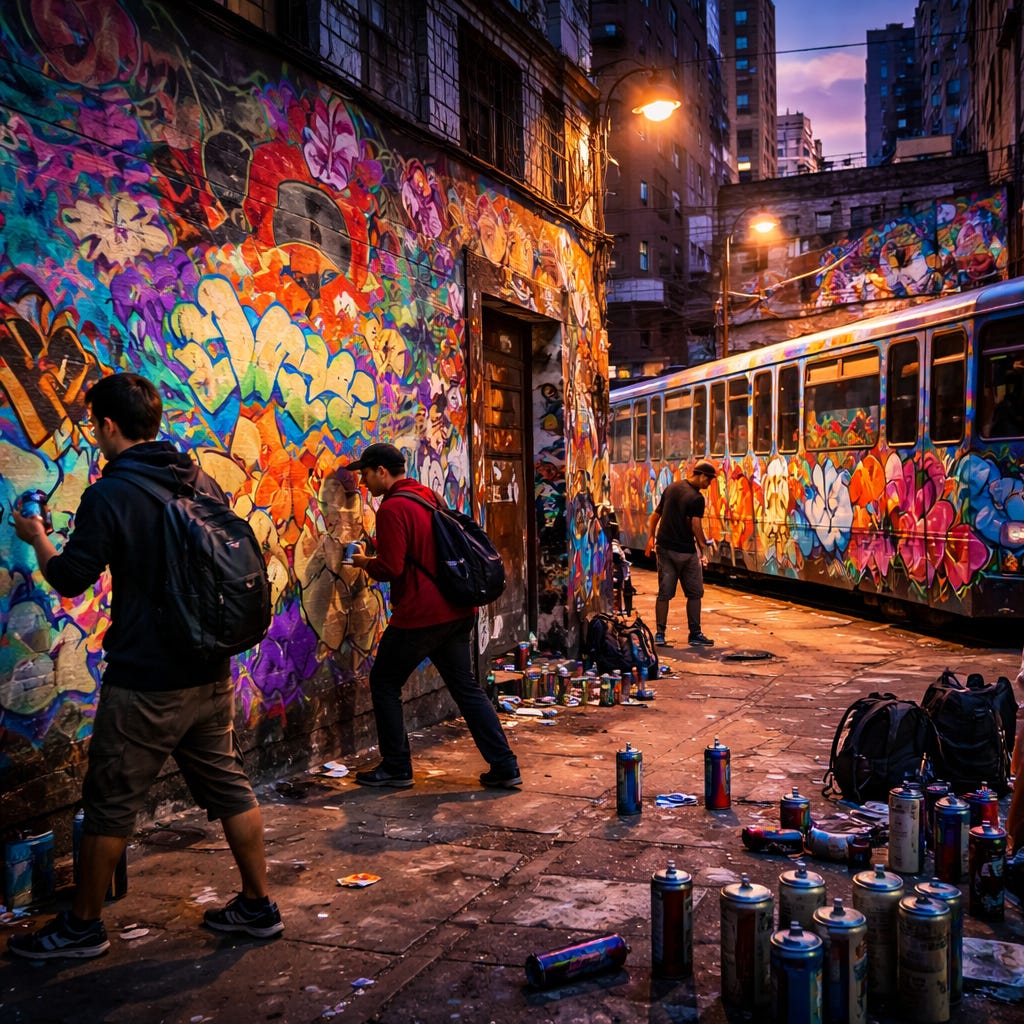
Street art is often dismissed as chaos, as vandalism that mars otherwise orderly urban spaces. But for those who look closely, it is a language, a rhythm, and an unpolished but powerful expression of creativity. My own encounters with street art have been intermittent yet revelatory, often sparked by a chance walk through an alley or the fleeting glance of a painted subway car. What struck me immediately was not just the color, but the confidence in the hand that wielded the spray can, the deliberate rhythm of strokes across brick and steel.
For me, street art has always existed in tension between anonymity and exhibition. Young artists, most without formal training, craft elaborate murals on walls, buses, trains, and occasionally the sides of abandoned buildings. Their work is temporal, vulnerable to erasure by the next coat of paint or city ordinance, and yet remarkably persistent in influence. Unlike classical art displayed behind glass, this art is public, immediate, and engaged with daily life.
Curiosity led me to compare patterns from city to city. In New York, the tags are frenetic, layered, a cascade of colors that seem to compete with the skyline itself. In Chicago, the murals display a sense of narrative, each piece telling a story of local identity and history. Los Angeles leans heavily into abstract forms, shapes sprawling across walls in unexpected geometries. Traveling from one urban landscape to another, I noticed certain motifs repeated: the jagged outlines of letters, the use of vibrant complementary colors, and an intuitive understanding of negative space. Despite the variety of cities, despite the individuality of each artist, a pattern emerges—a visual dialogue connecting young creators across space and time.
What is striking is not just the artistry, but the audacity. These artists operate in public, in daylight and under streetlights, often without permission, yet with an awareness of the impact of their work. There is a discipline to it: a planning of composition, a careful selection of surface, a knowledge of visibility and perspective. Every wall, every bus, every subway car becomes a canvas chosen for maximum engagement.
I also wondered about recognition. Formal institutions rarely reach out to these artists. Gallery exhibitions of street art exist, but they are often sanitized, removed from context. The raw vitality—the imperfections, the immediate dialogue with the urban environment—is lost. One young artist I encountered explained that he learned by observation, by trial and error, and by watching the work of others in the same city or even in distant cities through photographs online. Talent, training, and community converge in unexpected ways.
It is impossible to ignore the social and cultural implications. Street art is commentary as much as aesthetic. It responds to politics, to economics, to identity, and to injustice. Layers of paint accumulate as a visual archive, encoding experiences and perspectives that might otherwise remain invisible. In a sense, these murals and tags are contemporary oral histories, told in color and form rather than in words, accessible to anyone who takes the time to look.
What does this mean for observers like us? First, it challenges us to see beyond the surface. What might initially appear chaotic or juvenile is often the result of careful deliberation. It invites humility: we do not own the streets, and we are merely visitors to a dialogue centuries in the making. Second, it emphasizes connection. Despite anonymity, these artists are part of a larger conversation that spans continents. A tag in Berlin might echo one in New York. An abstract mural in Los Angeles might find its counterpart in São Paulo. Patterns emerge in the most unlikely places, hinting at universality in expression and intent.
Ultimately, street art asks us to reconsider value. Art need not hang in a gallery to be significant. Its impermanence is its power. Its public visibility is its reward. Its creators operate at the edge of risk and reward, finding a voice in the city itself. And for those who pay attention, the walls speak in symphonies, in colors and shapes that demand observation, contemplation, and, above all, recognition.
To walk these streets is to hear the music, see the rhythm, and appreciate the audacity of those who dare to make walls sing. Street art is not chaos; it is conversation. It is a testament to creativity, community, and the courage to express what others might overlook.

This is such a fascinating study, Alex! Very intriguing concept. Since we both live in more rural areas now, it would be interesting to explore how folk art in Appalachia and other areas reflects the communities around it. Would you like to team up?